Hazel is not just a mythic tree or a craft material; it is a keystone species in the temperate woodland web. A Hazel thicket is its own small world: a sheltering understory for birds, a mast source for mammals, a nectar stop for insects, and a structural backbone for coppice cycles that humans have shaped for thousands of years. Where Hazel grows, the woodland feels denser, more alive, more inhabited. Its quick regrowth after cutting creates a shifting mosaic of light and shade that supports everything from bluebells to nightingales. Hazel is a tree that makes room for others.
Hazel’s nuts are the heartbeat of its ecology. Red squirrels, dormice, wood mice, jays, nuthatches, and even wild boar depend on Hazel mast to survive winter. A good Hazel year ripples outward: squirrels breed earlier, dormice fatten, jays cache hundreds of nuts and accidentally plant new groves. A bad Hazel year tightens the whole system. Disease plays a quiet role here. Bacterial blights and cankers can reduce nut yield or cause early nut drop, reshaping the food calendar for every creature that relies on Hazel’s autumn abundance. Ecology is timing, and Hazel’s timing matters.
Hazel’s wood and bark also respond to stress in ways that matter for craft. Disease‑stressed stems sometimes develop subtle discolorations or streaking, not quite spalting but enough to give turned objects or carved charms a bit of character. Cankers and lesions can change bark texture, which affects basketry and twig craft. Even Hazel charcoal shifts with the health of the wood: softer, more brittle, or finer‑grained depending on how the tree lived. In this way, Hazel’s ecological story becomes a material story; the woodland written into the wood.
Hazel’s diseases themselves are part of its ecological identity. Bacterial pathogens like Xanthomonas arboricola and Pseudomonas syringae can overwinter in buds, spread by rain splash, and cause leaf lesions, cankers, or dieback. These infections rarely kill Hazel outright, but they shape its growth, its mast cycles, and its interactions with the animals that depend on it. They also shape human perception: a diseased Hazel rod was traditionally considered untrustworthy, a branch that “lies.” Healthy Hazel was the truth‑telling wood; the one fit for divining, blessing, boundary‑marking, and ritual use. Ecology and folklore meet in the same twig.
Hazel also participates in the wider climate system. Its early catkins feed pollinators emerging from winter. Its dense thickets stabilize soil and slow erosion. Its leaves decompose quickly, enriching the forest floor. Its flexible stems make it ideal for coppicing, a human‑tree partnership that creates habitat for countless species. Even Hazel’s vulnerabilities from frost, to pathogens, to drought, become part of the woodland’s rhythm, shaping which creatures thrive and which must adapt.
To understand Hazel ecologically is to see it as a node in a living network: feeding animals, sheltering birds, shaping crafts, responding to disease, and carrying centuries of human use in its grain. Hazel is not just a tree in the woods, it is a small ecosystem, a seasonal engine, a partner species. Its ecology is the quiet story beneath all the folklore, craft, and divination: the story of how a tree lives in the world, and how the world lives in it.
Extra
The pathogens that affect Hazel also move through orchards, vineyards, and other woodland species.
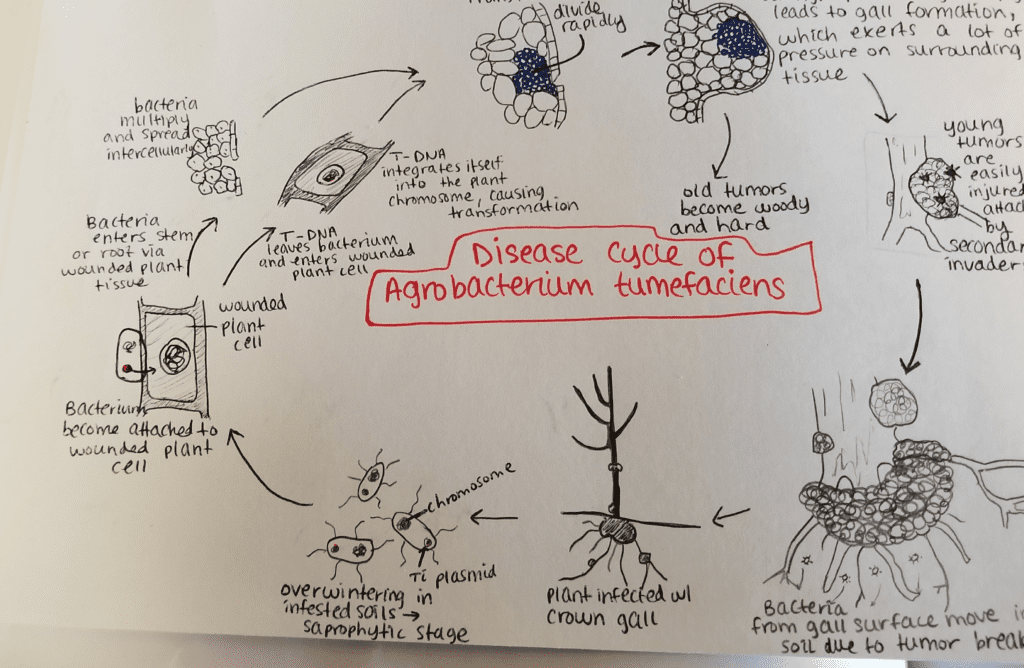
Disease cycle
Fungal diseases (Wikipedia links)
| Fungal diseases | |
|---|---|
| Anthracnose | Piggotia coryli = Monostichella coryli = Gloeosporium coryli = Labrella coryli |
| Armillaria root disease | Armillaria spp. |
| Borro sec | Cryptosporiopsis tarraconensis |
| Cytospora canker | Cytospora spp. |
| Eastern filbert blight | Anisogramma anomala |
| Kernel molds | Mycosphaerella punctiformis [teleomorph] Ramularia sp. [anamorph] Phomopsis spp. Septoria ostryae |
| Kernel spot | Nematospora coryli |
| Leaf blister | Taphrina coryli |
| Leaf spots | Anguillosporella vermiformis Asteroma coryli Cercospora corylina Cercospora coryli Mamianiella coryli Monochaetia coryli Mycosphaerella punctiformis [teleomorph] Ramularia sp. [anamorph] Phyllosticta coryli Ramularia coryli Septoria ostryae Sphaceloma coryli |
| Nectria canker | Nectria ditissima |
| Texas root rot | Phymatotrichopsis omnivora |
| Powdery mildew | Microsphaera coryli Microsphaera ellisii Microsphaera hommae Microsphaera verruculosa Phyllactinia guttata = Phyllactinia suffulta |
| Rust | Pucciniastrum coryli |
Viral diseases (Wikipedia links)
| Viral diseases | |
|---|---|
| Hazelnut mosaic | genus Ilarvirus, Apple mosaic virus (ApMV) genus Ilarvirus, Prunus necrotic ringspot virus (PNRSV) genus Ilarvirus, Tulare apple mosaic virus (TAMV) |
Phytoplasmal and spiroplasmal diseases (Wikipedia links)
| Phytoplasmal and spiroplasmal diseases | |
|---|---|
| Filbert Stunt | unknown, suspect a phytoplasma |
| Hazelnut Yellows | phytoplasma |
Miscellaneous diseases and disorders (Wikipedia links)
| Miscellaneous diseases and disorders | |
|---|---|
| Blanks | empty nut shells, cause unknown |
| Brown Stain | brown liquefied portions of shell and kernel, cause unknown |
| Catkin Blast | deformed catkins, cause unknown |
| Sun Scald | high temperature |
| Wet Feet | saturated soil conditions for extended periods. |
Leave a Reply