
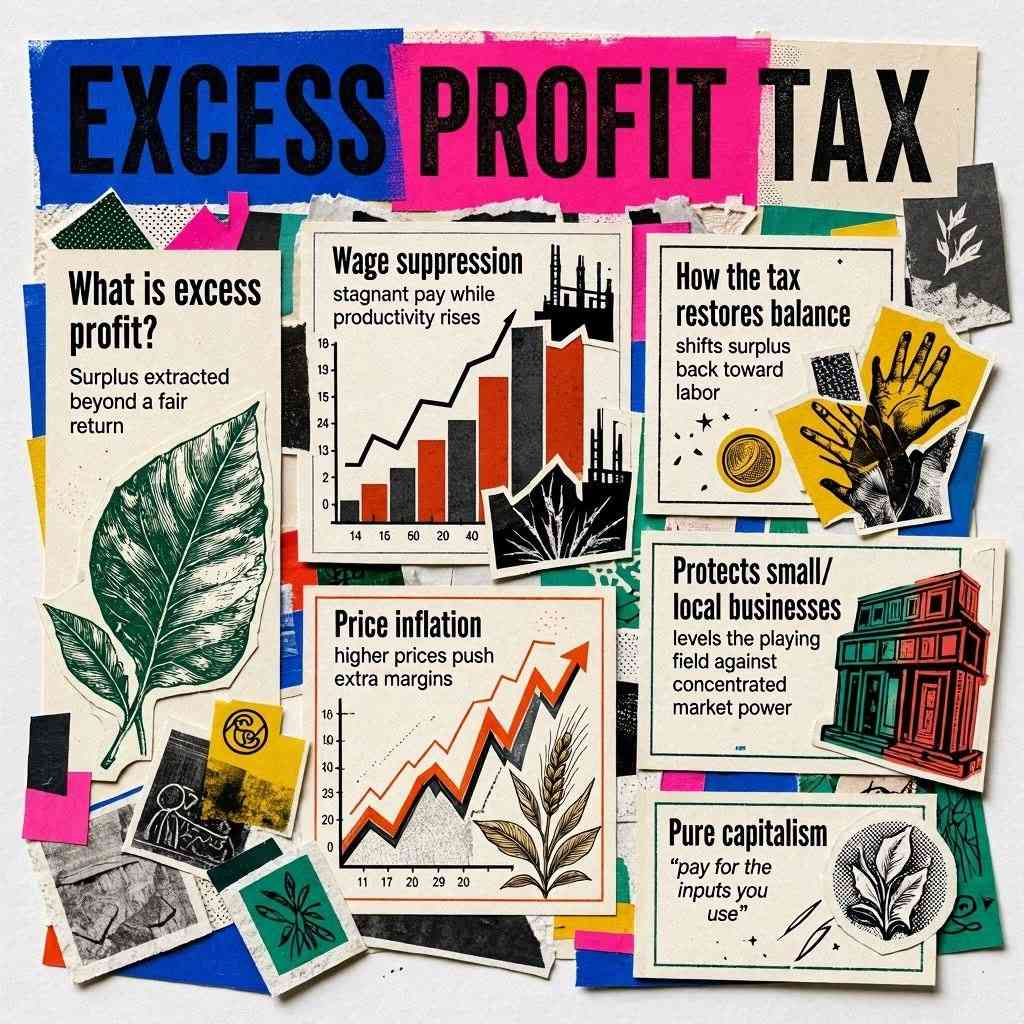
An Excess Profit Tax is designed to tax the portion of economic value created by workers that is not returned to them in wages. In modern U.S. labor markets, the average worker produces roughly $80/hour in value but is paid only $20/hour. The remaining $60/hour is not “entrepreneurial reward” or “innovation premium”; it is captured surplus generated by labor and retained by firms. Taxing only the $20 wages places the burden on the least compensated participant in the production process while leaving the majority of the value untaxed. An Excess Profit Tax corrects this distortion by taxing the extracted surplus, not the worker’s income.
This approach aligns with constitutional principles of taxation based on actual economic activity, not artificially suppressed wages. When firms suppress wages below the value created, they shift the tax burden onto workers and the public, while privatizing gains. An Excess Profit Tax prevents this by treating the surplus as taxable profit rather than pretending it does not exist. It does not punish productivity; it prevents firms from converting public infrastructure, labor, and market stability into private windfalls without contributing proportionally to the society that enables those profits.
Historically, Excess Profit Taxes have been used during periods of extreme inequality or wartime profiteering. The United States applied them repeatedly in the 20th century — including World War I, World War II, and the Korean War — because they were the fastest and most effective way to prevent firms from extracting extraordinary gains during crises. They worked by taxing profits above a normal baseline, ensuring that firms could operate and innovate while preventing runaway accumulation at the top.
In the modern context, an Excess Profit Tax would target the gap between worker productivity and worker compensation. If a firm pays $20/hour for labor that produces $80/hour in value, the $60/hour difference is the taxable surplus. This revenue could fund wage floors, public goods, or direct rebates, effectively raising real incomes without waiting for employers to voluntarily increase pay. It is fast, targeted, and structurally sound. It recognizes that the majority of economic value is created by workers, not by capital, and ensures that taxation reflects that reality.
The core principle is simple: Tax the value that exists, not the value that has been hidden. An Excess Profit Tax makes the captured surplus visible, taxable, and accountable — restoring balance between labor, capital, and the public good.

Leave a Reply