Biochemistry
-
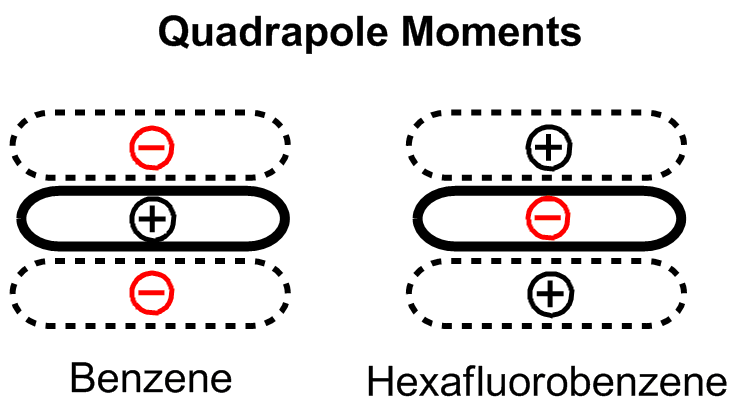
Electrostatic model (substituent effects)
An early model for the role of substituents in pi stacking interactions was proposed by Hunter and Sanders. They used a simple mathematical model based on sigma and pi atomic… Read more.
-
Substituent effects
The ability to fine-tune pi stacking interactions would be useful in numerous synthetic efforts. One example would be to increase the binding affinity of a small-molecule inhibitor to an enzyme… Read more.
-
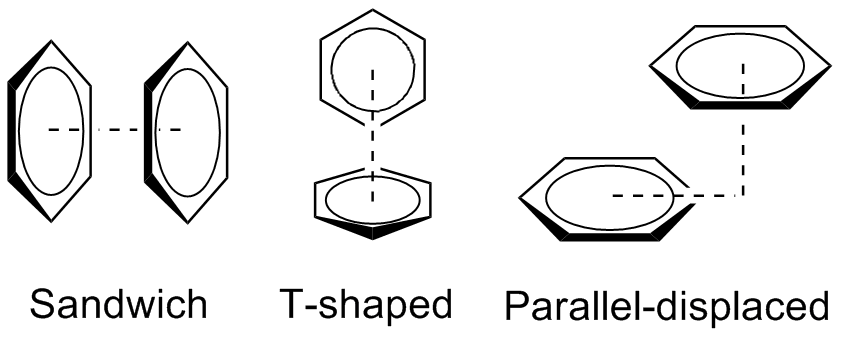
Geometric configurations
The preferred geometries of the benzene dimer have been modeled at a high level of theory with MP2-R12/A computations and very large counterpoise-corrected aug-cc-PVTZ basis sets. The two most stable… Read more.
-
Evidence against pi stacking
The benzene dimer is the prototypical system for the study of pi stacking, and is experimentally bound by 8–12 kJ/mol (2–3 kcal/mol) in the gas phase with a separation of 4.96 Å… Read more.
-
Pi stacking aka π–π stacking
In chemistry, pi stacking (also called π–π stacking) refers to the presumptive attractive, noncovalent pi interactions (orbital overlap) between the pi bonds of aromatic rings. However this is a misleading description of the phenomena since direct stacking of aromatic rings (the “sandwich… Read more.
-
AM404, aka N-arachidonoylphenolamine, is an active metabolite of paracetamol
AM404, also known as N-arachidonoylphenolamine, is an active metabolite of paracetamol (acetaminophen), responsible for all or part of its analgesic action and anticonvulsant effects. Chemically, it is the amide formed from 4-aminophenol and arachidonic acid. Pharmacology It is established that AM404 increases concentrations of the endogenous… Read more.
-
4-Aminophenol – what a molecule!
This is a humble organic compound with the formula H2NC6H4OH, but don’t let its unassuming structure fool you. This is not just any crystalline powder; this is a chemical that moonlights… Read more.
-
Paracetamol is an aniline derivative with a sketchy date of birth (and a very sketchy rebirth)
Paracetamol was first made in 1877…or possibly 1852. Some reports state that Cahn & Hepp or a French chemist called Charles Gerhardt first synthesized paracetamol in 1852. Acetanilide was the first aniline derivative… Read more.
-
Benefits of paracetamol for fever are unclear
Paracetamol (acetaminophen or para-hydroxyacetanilide) is a medication used to treat fever and mild to moderate pain. At a standard dose, paracetamol only slightly decreases body temperature; it is inferior to ibuprofen in that respect, and the benefits of its use for fever are… Read more.
-
Carbonic anhydrases (or carbonate dehydratases) and inhibitors
The carbonic anhydrases (or carbonate dehydratases) (EC 4.2.1.1) form a family of enzymes that catalyze the interconversion between carbon dioxide and water and the dissociated ions of carbonic acid (i.e. bicarbonate and hydrogen ions). The active site of most carbonic anhydrases contains a zinc ion. They are therefore classified as metalloenzymes. The enzyme maintains acid-base balance and… Read more.