-

Gorget patches are an insignia in the form of paired patches of cloth or metal on the collar of a uniform…just about everywhere
Gorget patches (collar tabs, collar patches) are an insignia in the form of paired patches of cloth or metal on the collar of a uniform (gorget), used in the military and civil service in some countries. Collar tabs sign the military rank (group of ranks), the rank of civil service, the military unit, the office (department) or the branch of the armed forces and the arm of
-

Gorget, From French Gorge Meaning Throat
A gorget, from the French gorge meaning throat, was a band of linen wrapped around a woman’s neck and head in the medieval period or the lower part of a simple chaperon hood. The term later described a steel or leather collar to protect the throat, a set of pieces of plate armour, or a single piece of plate armour hanging from the neck and covering the throat and chest. Later, particularly from
-
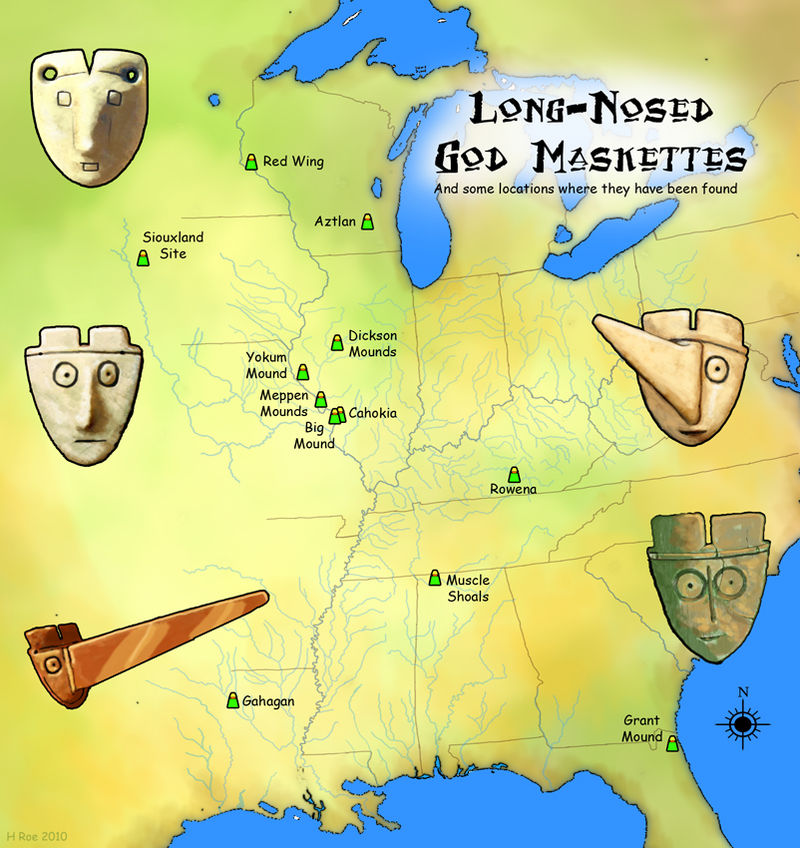
Long-nosed god maskettes are artifacts made from bone, copper and marine shells
Long-nosed god maskettes are artifacts made from bone, copper and marine shells (Lightning whelk) associated with the Mississippian culture (800 to 1600 CE) and found in archaeological sites in the Midwestern United States and the Southeastern United States. They are small shield-shaped faces with squared-off foreheads, circular eyes, and large noses of various lengths. They are often shown on Southeastern Ceremonial Complex representations of falcon impersonators as ear ornaments. Long
-
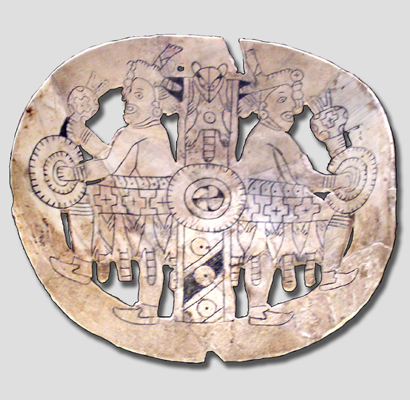
Shell gorgets
Shell gorgets are a Native American art form of polished, carved shell pendants worn around the neck. The gorgets are frequently engraved, and are sometimes highlighted with pigments, or fenestrated (pierced with openings). Shell gorgets were most common in Eastern Woodlands of the United States, during the Hopewell tradition (200 BCE– 500 CE) and Mississippian cultural period (ca. 800–1500 CE); however, tribes from other regions and time periods
-
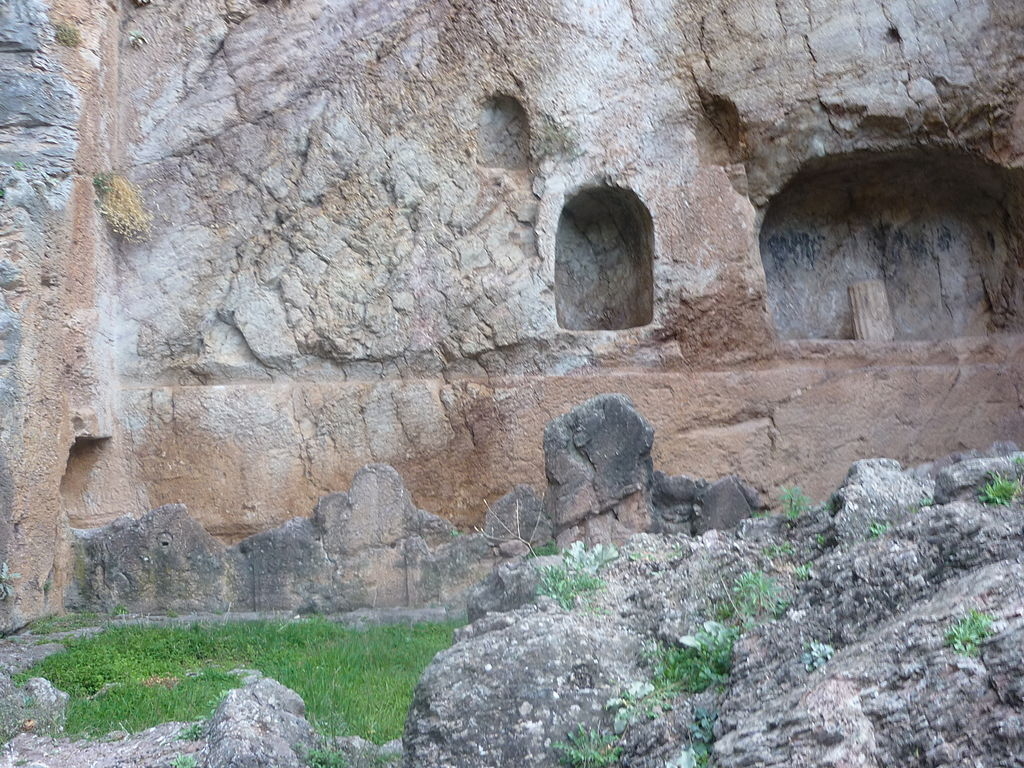
Castalian Spring
The Castalian Spring, in the ravine between the Phaedriades at Delphi, is where all visitors to Delphi — the contestants in the Pythian Games, and especially pilgrims who came to consult the Delphic Oracle — stopped to wash themselves and quench their thirst; it is also here that the Pythia and the priests cleansed themselves before the oracle-giving process. Finally Roman poets regarded it
-

Pterion and Pteron Notes
The pterion is the region where the frontal, parietal, temporal, and sphenoid bones join. It is located on the side of the skull, just behind the temple. Structure The pterion is located in the temporal fossa, approximately 2.6 cm behind and 1.3 cm above the posterolateral margin of the frontozygomatic suture. It is the junction between four bones: These bones are typically joined by five cranial sutures: Clinical significance Haematoma
-

United States v. Forty Barrels and Twenty Kegs of Coca-Cola, 241 U.S. 265 (1916)
United States v. Forty Barrels and Twenty Kegs of Coca-Cola, 241 U.S. 265 (1916), was a federal suit under which the government unsuccessfully attempted to force The Coca-Cola Company to remove caffeine from its product. Context In 1906, Harvey Washington Wiley was the head of the United States Department of Agriculture Bureau of Chemistry when Congress passed the Pure Food and Drug Act. The
-

Cryptanaerobacter phenolicus transforms phenol into benzoate via 4-hydroxybenzoate
Benzoic acid occurs naturally in many plants and serves as an intermediate in the biosynthesis of many secondary metabolites. Salts of benzoic acid are used as food preservatives. Benzoic acid is an important precursor for the industrial synthesis of many other organic substances. The salts and esters of benzoic acid are known as benzoates. Benzoic acid occurs naturally as do its esters in many plant
-
Rhodococcus phenolicus is a bacterium able to degrade phenol as sole carbon source
Rhodococcus phenolicus is a bacterium species in the genus Rhodococcus. Phenolicus comes from New Latin noun phenol –olis, phenol; Latin masculine gender suff. –icus, suffix used in adjectives with the sense of belonging to; New Latin masculine gender adjective phenolicus, belonging to phenol. This species is able to degrade phenol as sole carbon source. External links Categories:
-
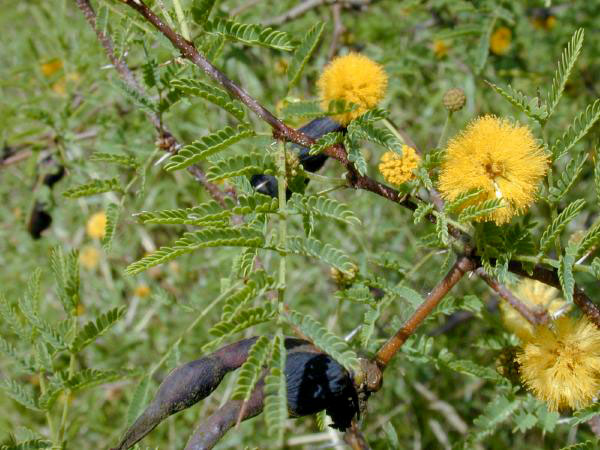
Farnesol and Farnesene
Farnesol is a natural 15-carbon organic compound which is an acyclic sesquiterpene alcohol. Under standard conditions, it is a colorless liquid. It is hydrophobic, and thus insoluble in water, but miscible with oils. Farnesol is produced from 5-carbon isoprene compounds in both plants and animals. Phosphate-activated derivatives of farnesol are the building blocks of possibly all acyclic sesquiterpenoids. These compounds are doubled to
Recent Posts
- TON makes ERA redundant because it forbids legal caste creation at the root
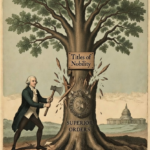
- Aristocracy is a poisonous weed and the TON clauses are weedkiller (in the unhinged spirit of Justice Scalia)

- Adams and Jefferson on Aristocracy: A Structural Disagreement in the Early Republic
- John Adams — Opinions of Philosophers — Anti‑Caste Constitutional Foundations
- Corporate “persons” are a perfect example of a Titles of Nobility (TON) violation
Tags
2025 agriculture alchemy anthropology archaeology art biochemistry biography biology chemistry civil rights crystallography culture duplicate ecology economics endocrinology entertainment entomology folklore genetics geology glossary hematology history immunology law linguistics materials science medicine mythology neurology philosophy physiology politics psychology public health religion reproduction science smoker's paradox symbolism systems theory technology toxicology